|
Since its reawakening on the Nintendo 3DS, Fire Emblem has become a flagship series for Nintendo. The 3DS entries’ shift to player-friendly mechanics like causal mode blunted some of its edge as a Strategy RPG, and a greater focus on characters and relationships brought in an audience willing to engage with its systems if it meant spending time with casts they loved. Fire Emblem: Three Houses on Nintendo Switch harnessed the mass appeal of the series’ modern entries to become the best-selling game in the series, and though Fire Emblem Engage’s mixed reception seemed to suggest that the magic was lost, the newest game is determined to capture lightning in a bottle a second time. Fire Emblem: Fortune’s Weave for Nintendo Switch 2 returns to the world of Three Houses with daring ambition, and while it does have some unexpected quirks, first impressions lead me to believe it could be the series at its most grand and exciting. |
Five years have passed since the end of the Heroic Games and the Dagdan Empire has since been brought to its knees by the Demon God Balor. Players awaken to the apocalypse as Eshmel, a guardian warrior blessed by the goddess of fate Fortuna, and join the remnants of humanity in pushing back the underworld’s forces. Woefully outgunned, Fortuna tasks Eshmel with returning to the games’ beginning and shepherding Dagda’s greatest fighters—the Flame Lords—to the future, where their powers can be used to end Balor’s reign of evil. Though players can take on Balor from the start, the impression is that they are intended to complete all four stories to make the final boss more manageable through the Flame Lords’ powers. |
The game’s opening immediately dispels notions of it being business as usual, with Dagda’s future being home to firearms, automated turrets, and even quantum computers. Though not without precedent, as Three Houses showed that advanced, magic-based technology existed in this world, it is rather jarring and may leave some fans shaken due to the departure from the series’ consistent medieval setting. That initial shock and the ensuing skepticism is amplified by some of the character designs, which carry Engage’s extravagant artstyle forward. The Flame Lords— Cai, Dietrich, Theodora, and Leda—are very well-designed, but more than a few secondary characters in both the future and past stick out with their colourful hair and attire that doesn’t mesh with their surroundings. Luckily, the core of the game is very much about the Heroic Games and the lords, so neither of those issues are all too disruptive. |
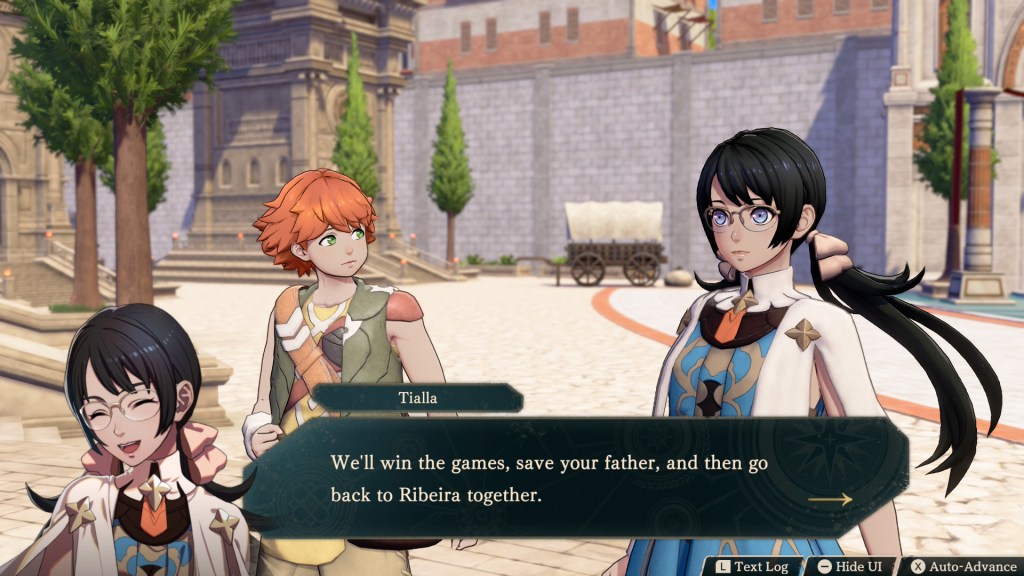
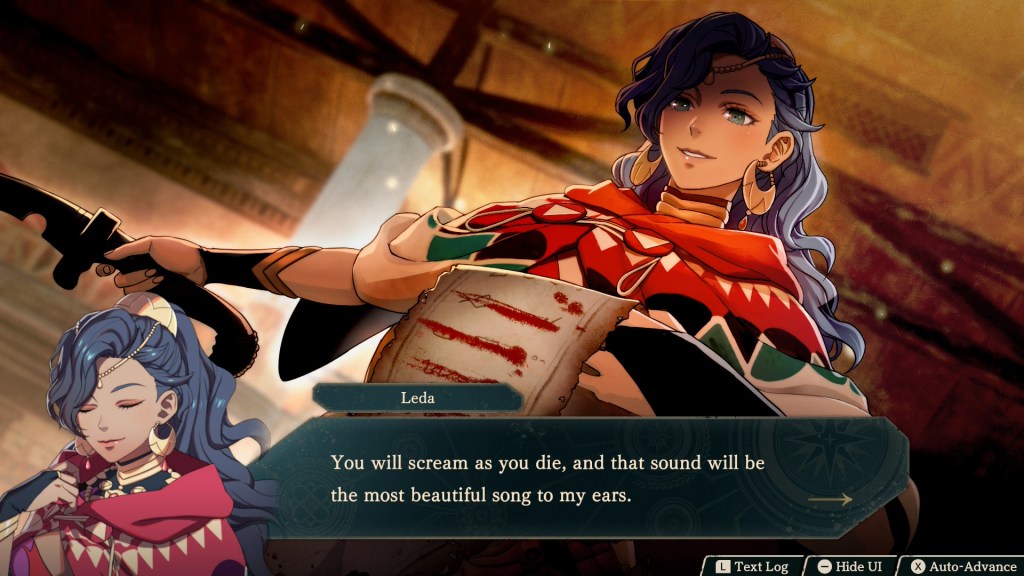
All four routes can be advanced in one playthrough and they vary considerably in their tone and key features. Cai’s battle to free his imprisoned father with the help of his friends has the energy of a shonen anime, while Leda’s bloody rampage against those who wronged her seeps with edginess. Meanwhile, Queen Theodora’s campaign to restore the glory of the goddess Yu Phas has the hallmarks of a traditional Fire Emblem story, and Dietrich’s journey to find ever-stronger opponents is a wild card, boasting an off-beat protagonist, strange companions, a dose of humor, and considerable insights into the world’s lore. Cai’s story feels the most approachable and tight, but all four feel somewhat rushed when compared to past games in the series or other RPGs, as the lords’ origins are glossed over to make way for their roles in the tournament. There’s cause for celebration, however, in that all routes are worth playing, as their very pronounced differences means that there’s something new to be experienced in each. |
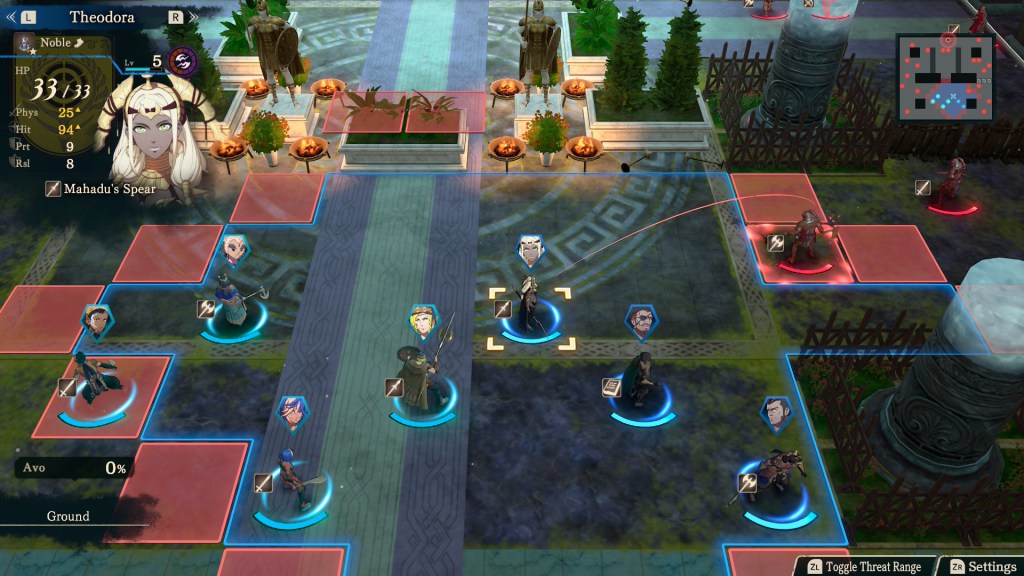
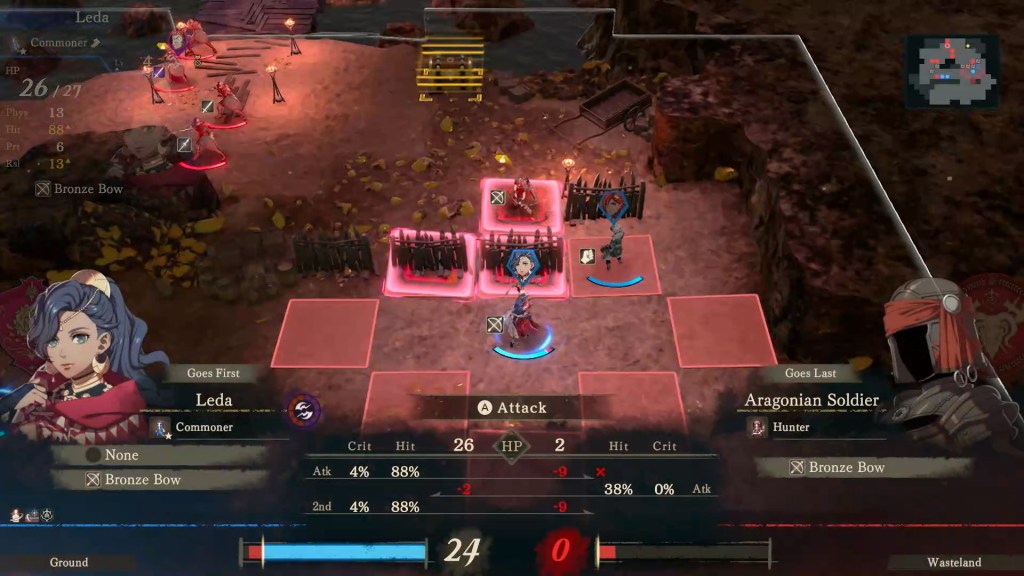
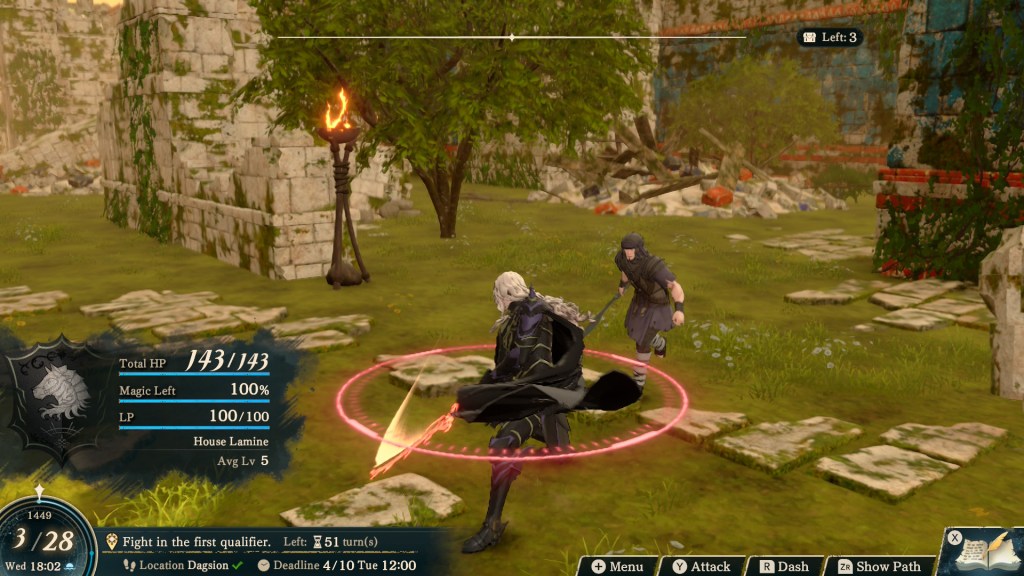
The Flame Lords each have gameplay systems exclusive to them, with Cai and Theodora, for instance, having dominion over mounts and battalions respectively. The new Blaze Arts, which drain health in exchange for a powerful ability, differ between them as well, with Dietrich’s allowing him to warp several spaces away and Leda’s instrument-playing granting buffs to allies. Though all the routes share common quests, as well as dungeons— a very welcome addition after their last appearance in Fire Emblem Echoes: Shadows of Valentia on the 3DS— most main story maps and events are, so far, unique to each. A gimmick and puzzle-like map that appears in Leda’s route suggests that the game is willing to experiment with its grid-based battles and mix things up between routes, and fans may be pleased to know that the gameplay appears to be consistently excellent and, unlike the story, without any real points of concern. |
Once in the Imperial Capital of Dagsion, the Flame Lords settle into their tournament lives and turn the pages of the calendar by honing their skills, solving the problems of the citizenry, deepening bonds between their units, recruiting new fighters, and exploring the world in search of treasures, dungeons, and skirmishes. There’s a strong undercurrent of adventure that, even when paired with some of the anxiety that comes with a time management mechanic, makes it a very welcoming and fun game to play. |
There are countless systems to juggle and always something to do, and when spread across four routes, it makes for an experience that pulls players in and makes some of its peculiarities easy to ignore. It feels as if developer Intelligent Systems is making a genuine effort to convince players to complete the whole game, and not just one route as was common with Three Houses. Just having the grid-based battles and unit management central to the series would have been perfectly acceptable, if not preferred by some fans, but a renewed emphasis on questing, dungeon-crawling, and other new or expanded mechanics raises its stock as an RPG and may bring on many who were otherwise convinced Fire Emblem wasn’t for them. |
Its presentation is of high quality, with Three Houses’ considerably ugly and subpar visuals being a relic of the past. Though pop-in and some muddy textures rear their head from time to time, its brighter colours and livelier artstyle, even when considering some of the character designs, do wonders for it. It seems to run at a stable 30 FPS, and it currently lacks a choice between a quality or performance mode. The only big visual hiccup thus far is that melee attack animations don’t flow well into each other— characters slide or jerk forward instead of moving naturally, though this can be fixed in a patch. |
All in all, it meets the standards for such a big release, though whether it is getting every iota of power out of the Switch 2 is something that Digital Foundry and other experts can ascertain. By its very nature, Fortune’s Weave is not as graphics-intensive as some other action and open-world games already released for the console, and active gameplay looks to provide a battery life of around three to three and a half hours, which puts it in the middle of the road when it comes to its burden on the system. As for audio, the English and Japanese voice casts are pulled from the top shelf, and the soundtrack so far has a wide range and some standout themes. |
Though the overarching story and some creative decisions instill mild caution, there’s more than enough good on display within the early stages of the game to consider Fire Emblem: Fortune’s Weave a confident pre-order recommendation. The four routes offer vastly different stories and gameplay experiences, while first impressions show that the questing, social simulation, unit management, and dungeon-crawling have all been implemented in a very satisfying way. New mechanics are introduced practically every hour, and twists on old ones ensure that longtime fans get to experience something fresh. Fire Emblem: Fortune’s Weave is shaping up to be the series at its most ambitious and inviting, with it making full use of both the strategy and RPG halves of its SRPG labeling, resulting in what may be a dangerously addictive title that’s hard to top—as long as it can win the whole tournament, and not just the opening round. |
A copy of Fire Emblem: Fortune’s Weave was provided by Nintendo UK for the purposes of this preview. |
|
|
|
|







0 Comments:
Post a Comment