|
For a series that began as a new IP on the Wii U of all systems, no one could have predicted the juggernaut that Splatoon, a uniquely colourful, online multiplayer shooter, has since become, with the now iconic Inkling standing right alongside Mario, Link, and Isabelle at the front entrance of Nintendo’s retail locations. With the success of Splatoon 2 and Splatoon 3 on Switch, it was only a matter of time before the Switch 2 got its own exclusive entry, but before diving into the inevitable Splatoon 4, Nintendo is trying out something a little different. While Splatoon is no stranger to single-player experiences, like the DLC expansions and underrated campaigns in the original trilogy, Splatoon Raiders is the first standalone title to put multiplayer on the wayside. Welcome to The Spirhalite Islands!
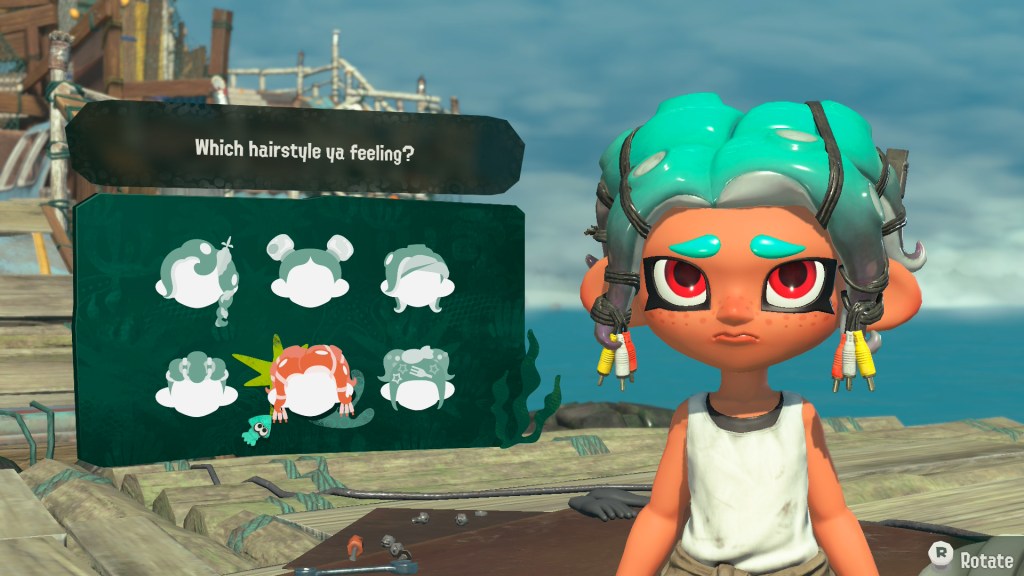
Splatoon Raiders begins with Shiver, Frye, and Big Man, members of idol pop group Deep Cut (as first introduced in Splatoon 3), aboard a helicopter with you, the pilot, traveling to a new location, The Spirhalite Islands, said to be full of treasure. After a mysterious beam of light shoots upwards from the center of their destination, a raging storm hits, causing the trio to crash land onto one of the nearby islands. Fast forward a month later, you find yourself on a Hideout Ship, a home base you’ve built, as it turns out your player character, either an inkling or octoling, male or female, you get to customize with preset hair styles, eye colours, and skin tones, is not only a pilot, but a mechanic, who you’ll be known as henceforth. Needing to collect materials to improve your Hideout Ship, you venture across the surrounding islands, defeating Salmonids in your path, and do what you came there for to begin with: raid all the valuable loot you can find. Although the narrative might feel a bit surface level to newcomers of the series, as told through snappy dialogue and an occasional animated cutscene, further lore is told through Briny Scrolls that can be found throughout the islands, the contents of which are sure to excite established Splatoon fans. |
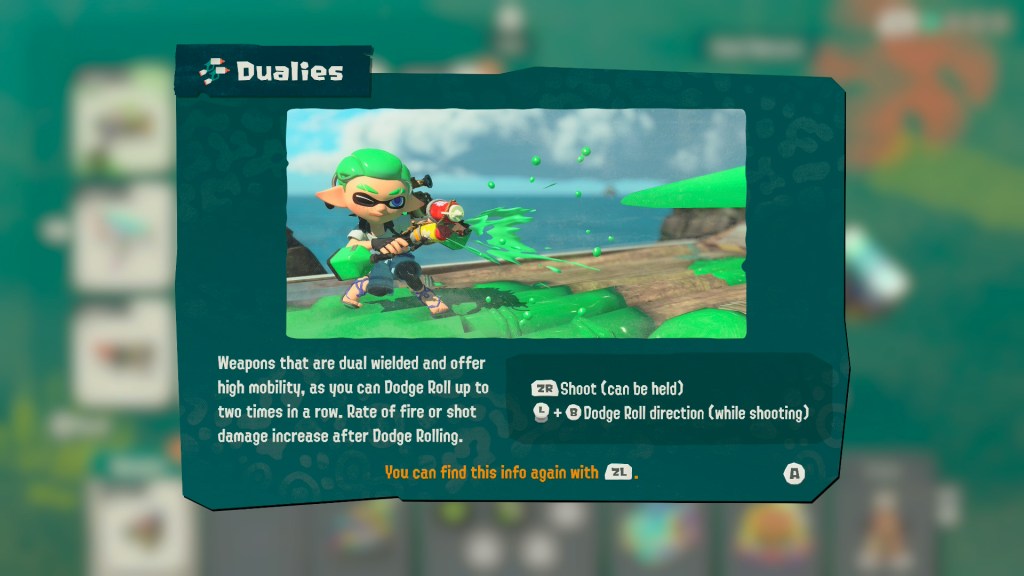
Three difficulty options are available to choose from at the start, Tourist, Raider, and Survivalist, with each increasing the strength of the enemy Salmonids. As a Splatoon veteran with hundreds of hours poured into previous titles, I opted for Survivalist, which offered a strong difficulty curve, providing a nice challenge without ever becoming overly frustrating. There’s a tutorial that goes over the gameplay mechanics at the start, and more abilities are unlocked as you progress, but the game doesn’t hold your hand, quickly throwing you right into the action. Splatoon Raiders’ controls feel fundamentally identical to Splatoon 3, whether it’s shooting ink with familiar weapon types (all of which make their return, sporting new recycled-looking designs, including my personal favorite, Dualies), aiming with the genre-defining (but optional) motion controls, or swimming through your splatted ink in squid form to recover ink, climb up walls, and swim through grates. While the way you navigate your environment as a swift-moving Inkling/Octoling hasn’t changed, some of the rules of gameplay most certainly have.
|
Splatoon Raiders doesn’t have a shortage of new mechanics (you do play as a mechanic after all). An exploration bot will automatically travel alongside you on your raids, pinpointing valuable crystals with its radar, and drilling them into Spirhalite Shards when you’ve defeated all the nearby Salmonids. Wandering around and helping to splat Salmonids on its own (can be helpful in a pinch, but doesn’t do any heavy lifting), the bot can be called to your exact location at any time so you can perform a bot hop, launching you into the air so you can reach high up platforms or briefly attack aerially. The bot is piloted by whichever Bot Buddy you’ve equipped from the Hideout Ship, either Shiver, Frye, or Big Man, and collecting enough Power Eggs from defeated Salmonids will fill up a Showstopper Gauge to perform an ultimate attack, which is unique depending on your chosen Bot Buddy, functioning similarly to and replacing the Special Weapons featured in previous Splatoon games. |
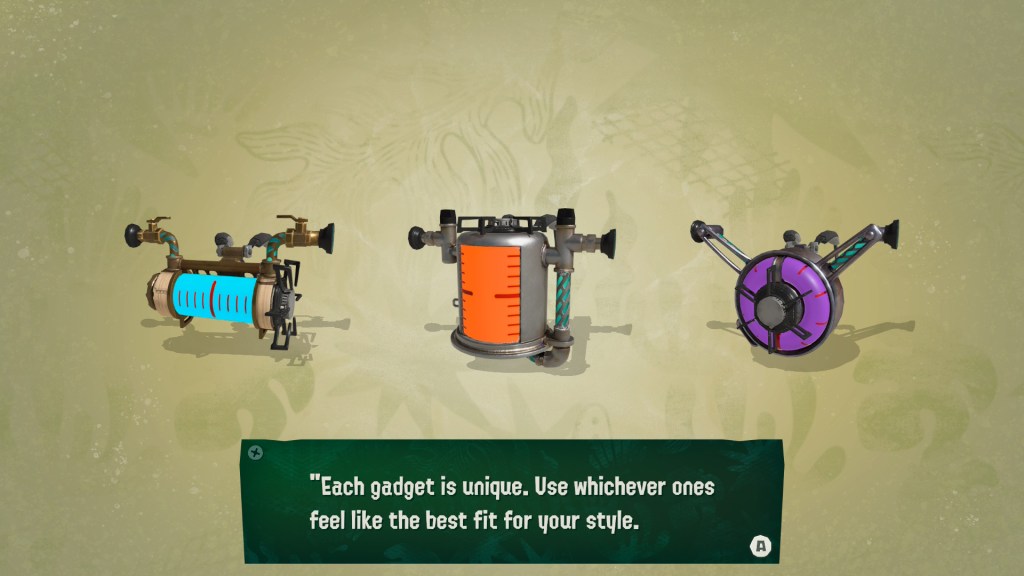
Another unique mechanic that’s introduced in Splatoon Raiders is the ink tanks. There are three types of ink tanks to swap between prior to entering a raid, offering an advantage in either speed, power, or tactics, with each one having unique gadgets that can be equipped to activate special attacks, which are infinitely reusable after a brief cooldown. Just like how Showstoppers replace Special Weapons, Gadgets essentially replace the Sub Weapons in this game, and are activated the same way. The Power Tank was my go-to, providing powerful close-range attacks to take on Salmonids head-on, but I found myself experimenting with all three, as different tanks are more useful on certain stages. Using Skill Points earned when leveling up, which is done by naturally earning experience while progressing through the game, all three tanks can be collectively upgraded to increase your HP (health), weapon damage, gadget damage, and number of gadget part slots. |
When it comes to weapon customization, choosing which gadget to use is only the first step, as you can also tinker with gadgets to modify them with different parts. Each gadget has a set amount of slots reserved for equipping parts, and each part takes up a certain number of those slots, depending on how strong or useful it is. Parts can have a large variety of effects, such as increasing damage, reducing cooldown, or strengthening other elements of the specific gadget. More parts are unlocked as you defeat more Salmonids, and you can develop new ones from the Hideout Ship using Spirhalite Shards and Salmonid Drops collected from all the islands you’ve raided. These materials are also used to upgrade the Hideout Ship with new facilities, leading to some of the upgrading options already mentioned, as not all are available from the start, and even more capabilities, like upgrading a weapon or scrapping unneeded ones (as new weapons are found throughout the islands).
|
When Splatoon Raiders was first revealed, a lot of people seemed to get the wrong impression that the game would be open-world, though as it turns out, it’s undoubtedly linearly level-based. While some of the areas are indeed more open, leaving room for exploration and finding hidden collectables, these areas, depicted as islands with uniquely stylized environments, are split up into stages on a world map, entered from the Hideout Ship, and each have a specific mission to accomplish before moving on to the next, but this is far from a bad thing. All in all, there are 5 types of stages you’ll encounter on the islands. |
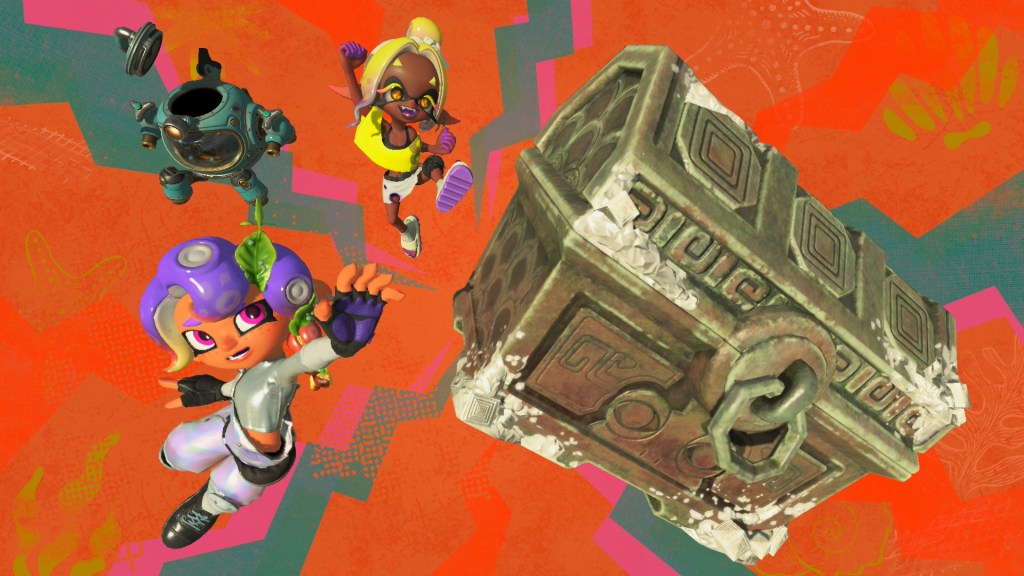
As mentioned earlier, a typical island raid involves following the waypoints of the exploration bot to mine crystals, defeating large hordes of Salmonids and Boss Salmonids (each with their own attacks and movement patterns, with many returning from the Salmon Run mode in Splatoon 2 and 3), and reaching a treasure chest at the end of the linear stage, which contains a valuable relic. Relics provide Relic Powers that can be equipped separately from Gadgets, offering up to five additional passive abilities, unlocked over time, to further aid you on future raids. Splatoon Raiders functions like a rougelite, as you keep all the materials and level-up progress that was made, regardless if the raid was successful. This is especially helpful for the brutal “Spicy” difficulty variants of previous raids that you’ll unlock later on, increasing the overall strength of the Salmonids. |
Another type of raid, though not as commonly occurring, plays out similarly, but instead of the stage being linear, it takes place in a larger, more open area, free to explore in any direction you please. The main goal here is to mine a specific huge crystal, marked by the exploration bot, but this can only be done after collecting enough Power Eggs, defeating the Salmonids surrounding smaller crystals spread across the map. Next up, we have stages referred to as “Dens,” which don’t contain any crystals at all, but rather challenge you to collect enough Power Eggs within a set time limit by defeating swarms of a specific Salmonid type in a small, more contained, area. Then we have “Buried Ruins,” essentially multiple sublevels of Dens that must be completed back to back without fail (given the three set lives provided for all the stages), with the final sublevel containing a more powerful Seasoned Salmonid boss, new to Splatoon Raiders. Lastly, Sampler Dungeons, unlocked by finding compasses hidden throughout the raids, are more casual stages, designed to challenge you to utilize a specific weapon or gadget without your usual equipped gear, and completing each one is a guaranteed way to earn an additional Skill Point. Rather than taking place on an island or a den, Sampler Dungeons reminded me of the missions from the Splatoon 2 Octo Expansion DLC, with a more industrial aesthetic. |
Despite being primarily focused on the single-player experience, it’s hard to imagine a Splatoon game without some sort of multiplayer mode, and Splatoon Raiders delivers (as long as you have an active Nintendo Switch Online subscription). Though far from being mandatory, as the entire game can be experienced solo, you can “call for help” to go through any of the raids online (or via local-wireless) with friends, or with randomly matched other players, and successfully completing a raid this way will reward you with more materials and gadget loot as a help bonus. Having had the opportunity to play through multiple online sessions, I found it to be a pleasant experience overall, without any lag or network interruptions, despite occasionally playing with others from overseas. While you wait for a match, you can even play addictive high-score based arcade games, as long as you’ve unlocked them for the Hideout Ship by spending the necessary Spirhalite Shards.
|
Another core staple that the Splatoon series has become known for is its high sense of fashion and variety of clothing options, and in my opinion, this is one of the only areas that Splatoon Raiders is lacking. Rather than being purchasable with some form of in-game currency, outfits are rewarded via unlock conditions, most of which occur just by playing through the game. Furthermore, outfits now come in one piece, no longer separated by headgear, tops, and shoes, are purely cosmetic, and there are only 32 in total, alongside 4 bonus ones that can only be unlocked by scanning the new Splatoon Raiders amiibo of Shiver, Frye, and Big Man, as well as any of the other Splatoon series amiibo for an additional Salmon Run-inspired outfit. |
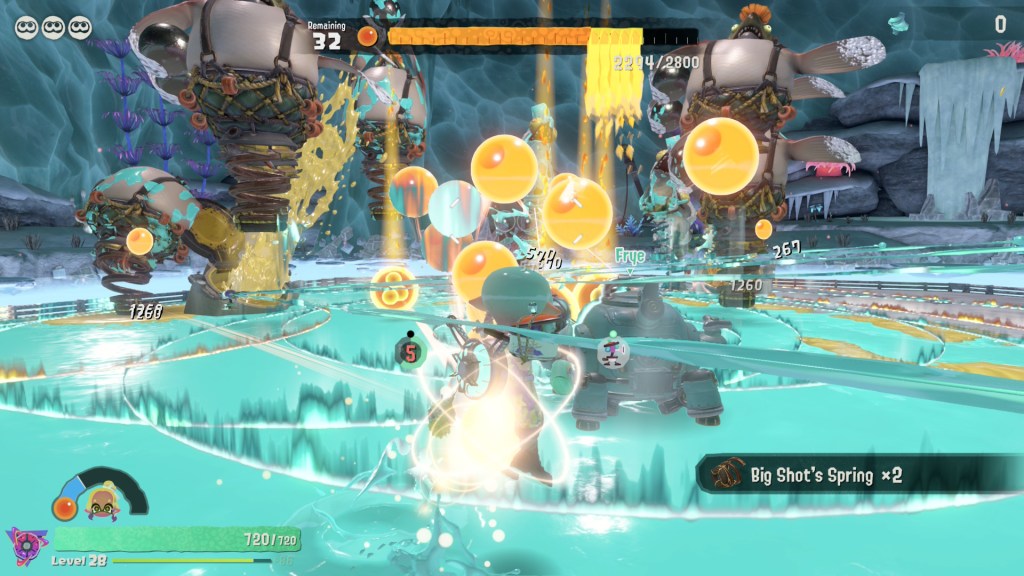
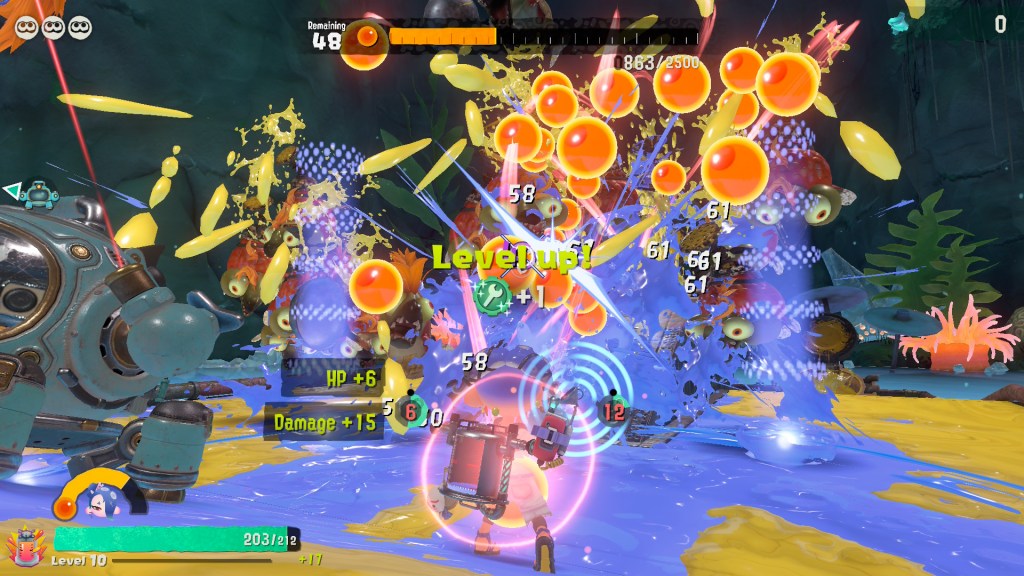
Closely matching, if not slightly better than, the visuals of Splatoon 3’s dedicated Switch 2 update, Splatoon Raiders has a dynamic resolution that allows the fast-action game to impressively run at a rock solid 60 FPS. The amount of enemies that can appear on screen at once without any noticeable dips, while still maintaining visual clarity, is frankly astonishing. Literally hundreds of Salmonids can be attacking, with different coloured ink splatting every which way and point counters flooding the screen, overwhelming your senses, and yet everything somehow remains competent and understandable, feeling thrilling rather than muddled, despite what screenshots suggest. While many of the environments have a dull, muddy appearance of greys and browns, the colourful, glossy ink makes for an excellent contrast to the post-apocalyptic style the game is going for. |
Splatoon Raiders is more than a spin-off; it’s an incredible launching point for a new branch of more single-player adventures, combining some of the best parts of the original Splatoon trilogy and turning it into something that feels fresh. Upgrading your arsenal as the Mechanic as you go from island to island, splatting hoards of Salmonids, is even more satisfying than it looks, and though the story isn’t too deep, the gameplay couldn’t be richer. Not only is Splatoon Raiders an essential addition to your Switch 2 game library when it launches 23rd July, it’s a splat-tastic reason to own Nintendo’s latest system in the first place. |
A copy of Splatoon Raiders for review purposes was provided by Nintendo UK. |
|
|
|
|