| Did you know the first Mario Tennis game was released over 30 years ago as an exclusive to the Virtual Boy? It's no coincidence that the latest entry for Nintendo Switch 2, Mario Tennis Fever, is releasing less than a week before the game library of Nintendo's infamous VR headset is being added as a benefit to Switch Online (+ Expansion Pack) subscribers. Mario Tennis has come a long way since the 90s, with Camelot Software developing a new spin on the sport for nearly every Nintendo console since the N64. The one for Switch, Mario Tennis Aces (2018), has started to show its age, and instead of receiving a dedicated Switch 2 Edition or update, Nintendo opted for a built-from-the-ground-up brand new title. So, does Mario Tennis Fever fill Ace's shoes, or is it a swing and a miss? Let's-a find out! | | In recent years, Mario sports games have gotten a bit of a bad rep for feeling incomplete at launch, with Nintendo relying on DLC and free updates to periodically add new content, specifically in regards to the character roster. Mario Tennis Fever aims to fix this common complaint from fans by including 38 characters in the base game, which is not only the most in series history, it's more than double what Aces started with, and 8 more than its finalized roster. Wiggler makes a return from Mario Power Tennis (GameCube/Wii), Baby Mario and Baby Peach are back from Mario Tennis Open (3DS), and newcomers include Nabbit, Goomba, Baby Luigi, Baby Wario, and the never-before-seen Baby Waluigi- even uglier than we imagined. | | Mario Tennis Fever itself is the exact opposite of ugly, possessing stunning visuals thanks to the increased power of Nintendo Switch 2. Mario Tennis Aces wasn't a bad looking game by any means, but the graphical improvements in Fever are very apparent, and not just due to running at a higher native resolution. Backgrounds are more detailed, NPCs are more lively and plentiful, and character models have higher fidelity, allowing for more fluid animations, both in-game and in pre-rendered cutscenes, resulting in the personalities of the characters shining through more than ever before. Donkey Kong's recent redesign, as featured in Mario Kart World and Donkey Kong Bananza, was created specifically for this level of expressiveness. On the contrary, not all the animations are there as a technical showcase, as even some of the intentionally simpler movements are charming, like Luma/Lumalee rapidly rocking back and forth in celebration of a victorious match. | |
Each character is categorized as All-Around, Technical, Tricky, Speedy, Powerful, or Defensive, having their own unique stats when it comes to speed, power, control, and spin. Stat differences between characters can vary from subtle to drastic, sometimes being immediately obvious, but not unfairly so. Not every character is unlocked from the start however, so you might need to hit the court right away if you wanna play as your favourite. Exact unlock conditions for each of the 20 locked characters, as well as color variations for Shy Guy, Yoshi, Koopa Troopa, and Koopa Paratroopa, can be found from the Achievements on the main menu, but most of them come down to playing a total number of tennis matches or completing one of the various modes. Unlock conditions for courts, Fever Rackets, and CPU difficulties can also be found in this menu.
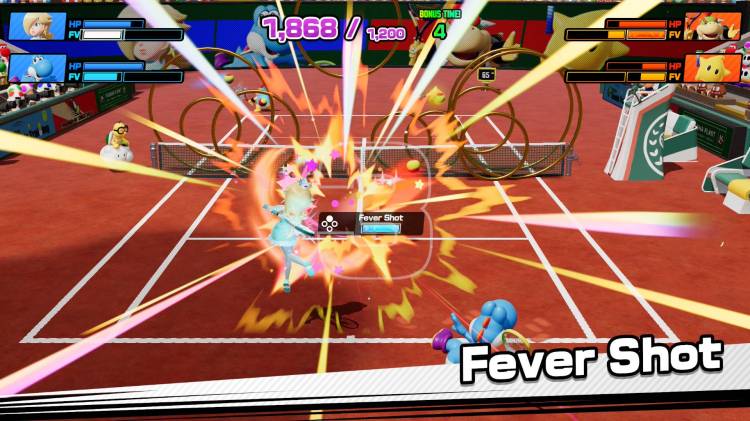
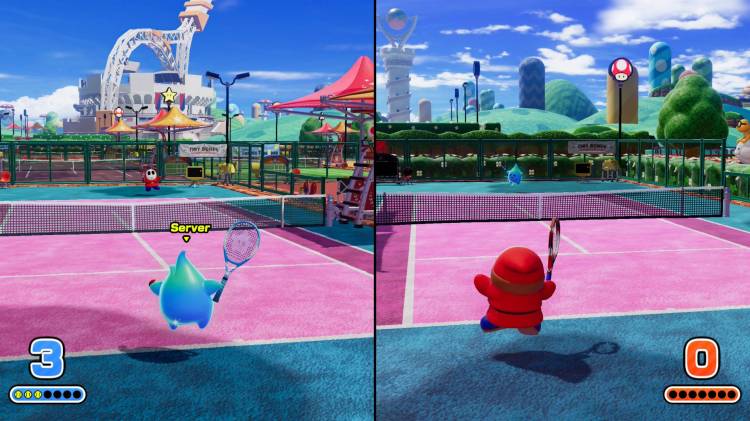
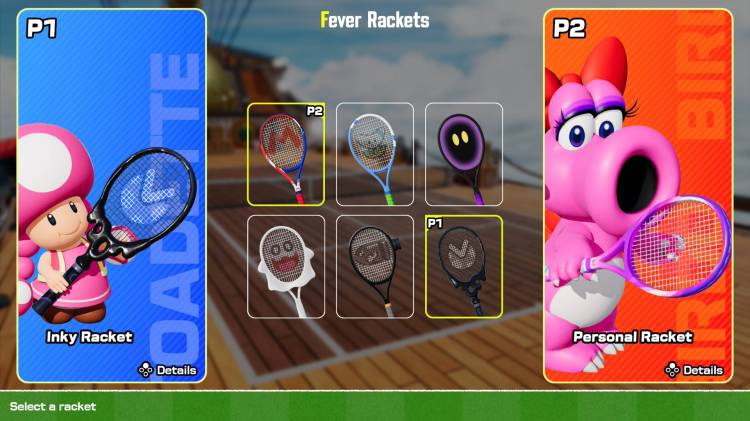
| | With characters aplenty, the court variety on the other hand, isn't so generous. Mario Kart World, hoisting a similarly premium price tag, has 30 unique race tracks, so Mario Tennis Fever only having 7 unique tennis courts feels a bit lacking. 7 isn't the whole story though, as the Stadium Court has grass, hard, and clay versions, and the Academy Court has wood, brick, carpet, mushroom, sand, and ice versions, each affecting the ball speed and bounce differently, technically making for 14 total court types. That's more than previous games in the series, but still leaves more to be desired. My favourite court is the Wonder Court though, themed after Super Mario Bros. Wonder, as it's cool to see the assets from that game in the third dimension. | | Gameplay wise, the actual tennis physics feel better than ever, with tighter controls and easier movability around the court, as the character leaps towards the tennis ball when you swing. Going from Aces to Fever, I immediately noticed the ball seemed to be a bigger, more obvious target. After doing a direct comparison, I realized that's because the camera is now considerably closer to the player character. While this new angle is a clear winner for my taste, the option is there to switch the camera to be more similar to Aces' if you prefer. What made the gameplay of Aces unique was its time-slowing Zone/Special Shots, which have now been replaced with a new gimmick, and it's one that more accurately puts the "Mario" into Mario Tennis. | | In Mario Tennis Fever, after selecting your character, you're also prompted to choose from 30 unique Fever Rackets (24 need to be unlocked), themed after various Mario power-ups and items. Instead of the Energy Gauge featured in Aces, you now have an FV Gauge that fills up during a rally, and once full, allows you to unleash a powerful Fever Shot, which uses the special ability of your Fever Racket. With proper timing, Fever Shots can be countered, and whoever's side of the court the ball lands on is the one who has to deal with the effects of the racket, whether it be your opponent's or your own. Some Fever Rackets are more defensive, like the Star Racket, making you temporarily invincible and boosting your speed, while others function more like attacks, such as the Flame Racket, spreading flames that do damage if touched. If your HP Gauge (depicted above your FV Gauge) gets depleted in a Singles match, you'll move slower until it refills, and in Doubles, you'll be forced to sit out of the match for 10 seconds. The Fever Shot mechanic is refreshing, perfectly chaotic, and arcade-style fun. | Adventure Mode (Single-Player) | |
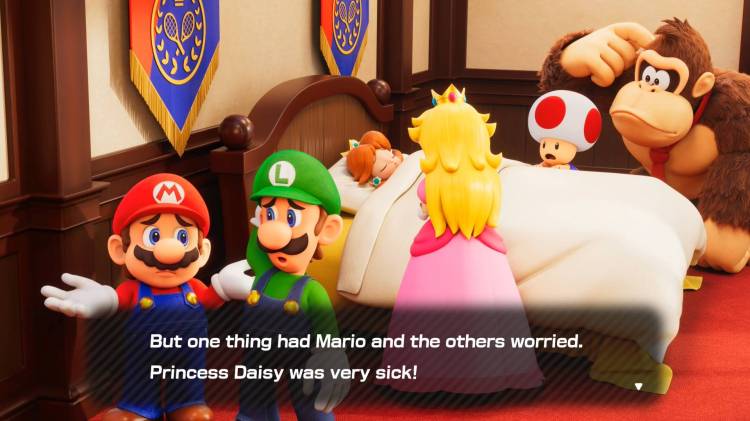
Just before the Mushroom Kingdom Tennis Tournament, Princess Daisy falls too ill to participate (perhaps "Fever" in the game's title is a double entendre). With everyone wanting her to feel better as fast as royally possible, Mario and friends travel to a mysterious island to retrieve a magic golden fruit. Though their mission of bringing it back to Daisy is successful, they now face a major hurdle of their own, as Mario, Luigi, Peach, Wario, and Waluigi are all turned into babies by the monsters within. In order to reverse the curse, the babies must go back to defeat them, but first, they'll have to regain their strength by training at the Toad-operated Mushroom Tennis Academy, starting in the junior-varsity class. For the purpose of the story, Baby Mario is the only playable character in Adventure Mode, with Baby Luigi acting as your Doubles partner when applicable, and Baby Wario and Waluigi being as comedically antagonistic as you would expect.
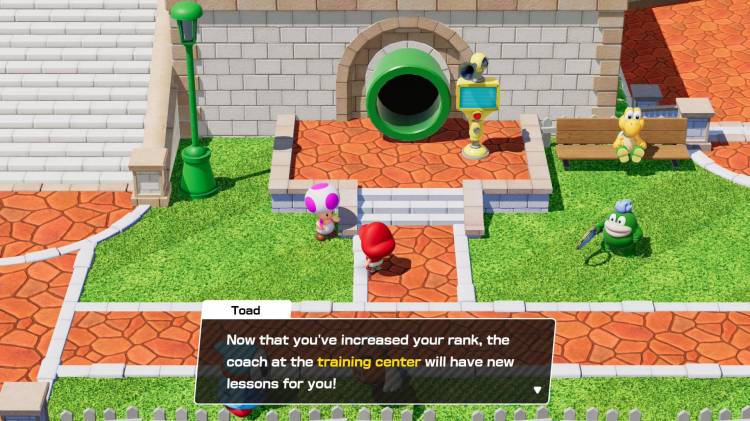
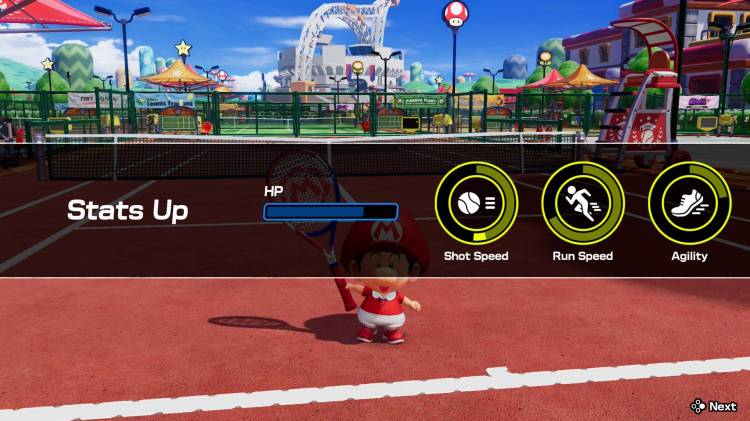
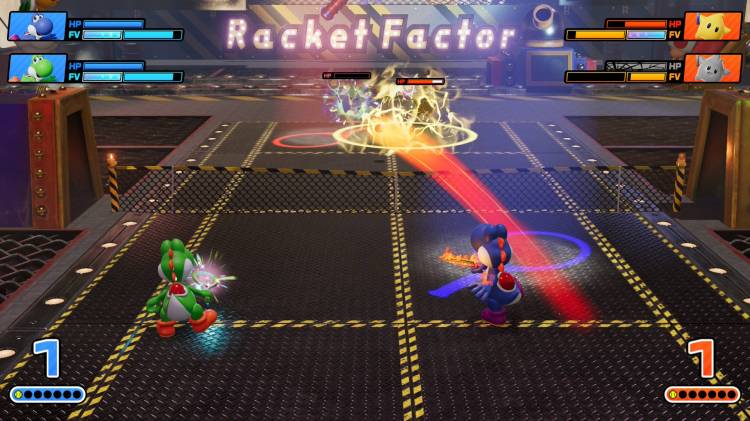
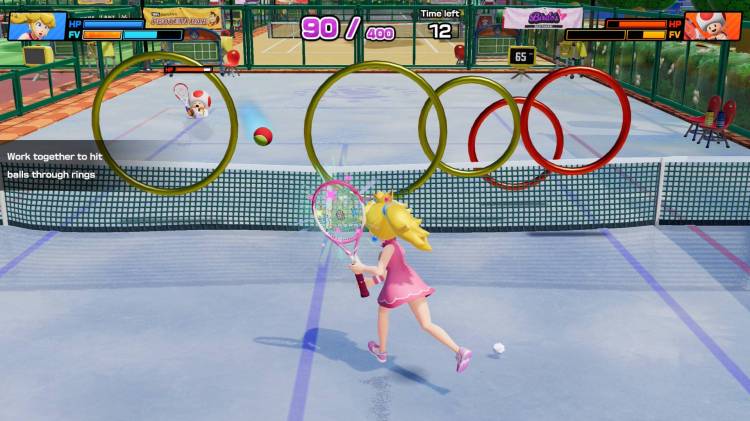
| | You start out by training at the Training Center, where you'll linearly use machines known as "Drill-o-matics" to play a very Mario Party-like minigame (each with three difficulty levels). These minigames are mostly unrelated to tennis, but help to improve various skills that will be utilized, such as timing, reflexes, control, and movement. Completing a Drill-o-matic will reward you with EXP in traditional RPG fashion, leveling up your character, increasing your Shot Speed, Run Speed, and Agility stats, and improving your topspin, slice, flat, lob, and drop shots. After each Drill-o-matic, Toad will give you an overview of a shot type and then have you practice it on the court, and once you've completed enough, you'll participate in a real rank-up match, working your way up from Rank E to Rank A, unlocking even more Drill-o-matics, getting quizzed on what you learned, and collecting stickers in the process. Wash, rinse, repeat, until the graduation tournament, where you'll prove you're ready to go up against the monsters that cursed you. | | Then, the real adventure begins, unlocking a World Map where you'll travel to new areas, compete in high-stake matches, and defeat unique bosses with tennis-like gameplay. Adventure Mode is one of the best tutorials I've ever played, and I mean that both genuinely and slightly backhandedly. Taking my time with it, I was able to complete everything the mode had to offer in just over 4 hours, with The Mushroom Tennis Academy taking up a majority of that time. The biggest challenge was the third difficulty level on each of the Drill-o-matics, which aren't even required to progress. With that being said, despite the hand-holding and underutilized RPG stats, I did still very much enjoy my time with Adventure Mode, especially what comes after the training. I just wish there was a lot more of it, as it feels like it ends almost as soon as it begins. | Trial Towers (1-2 Players) | | If Adventure Mode leaves you wanting more, the Trial Towers mode offers many more hours of arcade tennis action. Featuring three towers (Tower of Growth, Tower of Resolve, and Tower of Trickery) the goal is to scale the tower by completing 10 challenges in a row (given three lives), with pre-selected characters and Fever Rackets for you and your opponent. Challenges range from a round of tennis with special rules and/or Fever effects, to a Ring Shot challenge where you have to hit the tennis ball through rings to score points. The real fun though, comes from after you beat all three towers, as you'll unlock a whopping 100 individual trials you can take on at your own pace, each with three stars to earn by following the specified win conditions. If these trials were spread throughout Adventure Mode, it would have made it much more robust, so the fact that they're included here makes the overall package feel more complete in terms of content. If you need some help completing the three Trial Towers, a second player can join locally as a shadow version of your character, but individual trials must be done solo. | Tournament Mode (1-2 Players) | | Tournament Mode is the Grand Prix of tennis, with a Mushroom Cup (grass court), Flower Cup (clay court), and Star Cup (hard court) for both Singles and Doubles, each with three rounds, bracket style, and an increase in difficulty and match length. This mode offers a greater challenge than Adventure Mode, with Star Cup taking me multiple attempts. I was grateful that losing in the final round only made me restart the round and not the whole tournament, but depending on who you ask, that might defeat the purpose of it being considered a tournament in the first place. | | Nintendo really seems to love the Talking Flower from Super Mario Bros. Wonder. Not only are they soon releasing a physical version for your home, he now also acts as the commentator for your tennis matches. Although pleasant enough for a few rounds, as he does have a decent variety of different voice lines when calling out your shots, you might wanna turn off the commentary in the settings if it starts getting too repetitive. However, it's worth noting this only works for Free Play. I thought maybe I forgot to save my settings or there was some sort of glitch, but the toggle explicitly states: "can't be turned off in Tournament or Adventure, and Trial Towers and Mix It Up don't have commentary." Why even include the option at all then? | | Mix It Up includes even more ways to play, with Special Matches and Score Challenges. Special Matches can be played as Singles or Doubles and include the aforementioned Ring Shot (compete for the most points by hitting the ball through rings), as well as Forest Court (piranha plants pop up to eat and spit out the ball), Pinball (bouncy bumpers appear on the court for a pinball-inspired experience), Racket Factory (hit the lit-up panel on your opponent's side of the court to spawn a Fever Racket on your side), and Wonder Court (hit the Wonder Flower to transform the court and collect Wonder Seeds). These are best enjoyed with friends or family, but If you're playing solo, Special Matches have five CPU difficulties, with Novice and Intermediate unlocked at the start.
There are also four Score Challenges, each one with Beginner, Intermediate, Advanced, and Score Attack modes. 2P Co-op Ring Shot has you working with a partner to earn points, 4P Co-op Ring Shot is the same but with four players, and the last two Score Challenges are single-player: Piranha Plant Challenge, where you have to get the ball past your opponent without letting them return it, and Auto Tennis, where you aim your shots onto a grid on the court to score points. These challenges are great practice for those looking to improve their skills. | | Swing Mode gives that classic Wii Sports tennis feel by using motion controls for your shots, holding a single Joy-Con 2 (also compatible with the original Joy-Con) like a tennis racket. The type of shot is determined by how you swing rather than a button press, but swinging too early or too late might send the ball to the wrong side of the court. In Swing Mode, your character automatically moves towards the ball, allowing you to focus on your swings, but the stick still works for movement if you're wanting more precision. Only 6 Fever Rackets are available to use in this mode, but as a side-mode you'll likely only play when friends are around, that's more than serviceable. Just remember to wear your wrist-strap! | |
Being a multiplayer-focused title, Mario Tennis Fever includes all the bells and whistles for both online and offline play. In Free Play (local multiplayer) or when making an Online Room, customization options include match length (quick play, extended play, or custom), whether or not you wanna play with Fever Rackets (or even swap between two at once), and ball type (standard, slow, or high speed). If you're looking for something ultra competitive, Ranked Match encourages you to climb the world leaderboard online, and if you're looking for something more casual, GameShare allows you to play locally with others on their own Nintendo Switch, even if they don't own a copy of the game. There's no shortage of different ways to play tennis.
| | Mario Tennis Fever has a lot to love; easily being the best in the series both mechanically and visually. Adventure Mode is fun while it lasts, but is only about half the length it should have been, feeling more like a fleshed out tutorial than a challenging campaign. What makes up for it is the plenty of other modes and unlockables for you to spend your time with, the impressive and diverse character roster, and the new Fever Racket mechanic that finds the best balance between a Mario game and an actual tennis match we've seen thus far. The ball is in your court exclusively on Nintendo Switch 2 when Mario Tennis Fever launches 12th February 2026. | | A copy of Mario Tennis Fever for review purposes was provided by Nintendo UK. | | | | |











0 Comments:
Post a Comment